 Free Shipping $1,000+

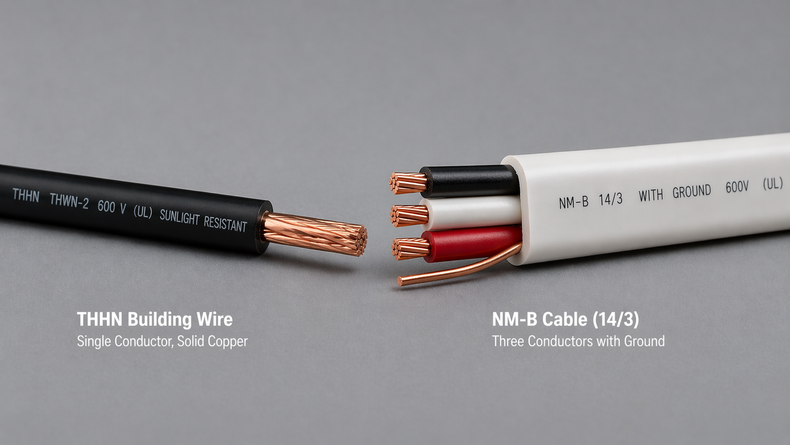
The difference between wire and cable comes down to a single conductor vs multi-conductor assembly. A wire is a single conductor — solid or stranded, bare or insulated — that carries one conductive path. A cable is an assembly of two or more individually insulated conductors combined under a shared outer jacket. The terms are frequently used interchangeably in everyday conversation, though in electrical catalogs, specifications, and code references they function as distinct product categories.
What Is the Difference Between Wire and Cable?
A wire is a single electrical conductor. It may be solid (one continuous piece of metal) or stranded (multiple thinner strands twisted together and treated as one conductor). It may be bare or covered with a layer of insulation. Across these variations, the defining characteristic is that a wire carries one conductive path.
A cable is an assembly built around two or more conductors. Each conductor is typically individually insulated, and the assembly is commonly bound together by an outer jacket that protects the internal components from moisture, abrasion, chemicals, and mechanical stress. Depending on the application, a cable may also include fillers, shielding, a drain wire, an inner tape, or metal armor.
The difference between wire and cable is both structural and functional. It affects how the product is ordered, how it is installed, which section of the electrical code governs it, and how distributors classify it in a catalog. Using the terms interchangeably is common in day-to-day conversation. In a spec sheet, bill of materials, or code compliance review, they map to separate product families.
Anatomy of a Wire
A wire is described by a short list of physical attributes:
- Conductor material. Most commonly copper, aluminum, or tinned copper. Material choice affects conductivity, corrosion resistance, and cost.
- Conductor size. Expressed in American Wire Gauge (AWG) for smaller sizes and in thousand circular mils (kcmil) for larger conductors. Smaller AWG numbers indicate larger conductors.
- Stranding. Solid wire is a single piece of metal; stranded wire is several thinner strands twisted together. Stranded wire is generally more flexible and easier to pull through conduit, while solid wire is stiffer and commonly used where a rigid termination is required.
- Insulation. Bare wire is commonly used for grounding and certain specialty applications. Insulated wire is classified by the insulation compound (PVC, nylon, XLPE, rubber, and others) and is designated by type codes such as THHN, THWN-2, XHHW-2, and RHW.
Common examples of wire include THHN and THWN-2 building wire commonly pulled through conduit, bare copper grounding conductors, magnet wire wound into motor coils, and appliance hook-up wire.
Anatomy of a Cable
A cable contains everything a wire does — and then some. A typical power or communications cable may include any or all of the following:
- Conductors. Two or more, each typically individually insulated. Conductor count is part of the cable's specification (for example, a 14/2 cable contains two 14 AWG insulated conductors, with a bare ground in the case of 14/2 with ground).
- Individual insulation. Each conductor is typically covered by its own insulation layer, usually color-coded for phase or signal identification.
- Fillers. Non-conductive material that maintains the cable's round shape and limits conductor shifting during installation.
- Shielding. Used where electromagnetic interference (EMI) is a concern. Shielding may be foil (a thin metallic film), braid (woven metal strands), or both.
- Drain wire. A bare conductor in contact with the shield, used to terminate the shield to ground.
- Inner jacket or binder tape. An optional layer that holds the core assembly together before the outer jacket is extruded.
- Armor. Interlocked metal tape or continuously corrugated aluminum that protects the cable from physical damage, found in metal-clad (MC) and armored (AC) constructions among others.
- Outer jacket. The final protective layer. Jacket compound — PVC, LSZH, thermoplastic elastomer, rubber, and others — is selected based on the installation environment, whether the cable is run in a plenum, buried underground, flexed continuously, or exposed to oils, chemicals, or sunlight. Each cable insulation material carries its own thermal, mechanical, and chemical tolerances.
Common examples of cable include NM-B cable (commonly referred to as Romex®, a registered trademark of Southwire), metal-clad (MC) cable, underground feeder (UF) cable, SOOW portable cord, RG-6 and RG-59 coaxial cable, Category 5e and Category 6 data cable, and fiber optic cable. These constructions correspond to different types of electrical wire and cable, each shaped by voltage class, environment, and signal characteristics.
Wire vs Cable at a Glance
| Attribute | Wire | Cable |
|---|---|---|
| Number of conductors | One | Two or more |
| Outer jacket | Uncommon (insulation only) | Typically present |
| Sold by | AWG, material, insulation type | Cable type, construction, conductor count, AWG |
| Typical install method | Commonly pulled through conduit or raceway | Often installed as a complete assembly, with or without conduit |
| Common examples | THHN, THWN-2, XHHW-2, bare copper ground | NM-B, MC, UF, RG-6 coax, Cat6, SOOW portable cord |
How the Distinction Affects Specification and Procurement
Misusing the terms wire and cable can produce three categories of downstream problems.
Procurement errors. If a purchase order asks for 500 feet of 14 gauge wire when the job actually requires 14/2 NM-B cable, the distributor ships single-conductor building wire. The order is then corrected, which delays delivery and can trigger restocking fees.
Code compliance. The National Electrical Code treats single-conductor building wire differently from cable assemblies. Each cable type — NM, MC, AC, UF, SER, and others — carries its own requirements covering where it may be installed, how it must be supported, and what additional protection it requires. For example, plenum vs riser cable ratings determine which assemblies are permitted in return-air plenums, risers, or general-purpose spaces; using a general-purpose cable in a return-air plenum is both a code violation and a fire-safety concern.
Installation planning. Individual wires pulled through conduit derate differently from the conductors inside a multiconductor cable. Bend radius, support intervals, and termination hardware are also specified differently for cable than for loose conductors. Treating wire and cable as identical can result in missed derating, fill, and labor factors on a bid.
In procurement practice, specifications frequently describe the function of the run — branch circuit, data drop, control signal, portable cord, and similar — with the product category following from the intended application rather than being selected independently of it.
Key Takeaways
- A wire is a single conductor. A cable is an assembly of two or more insulated conductors, typically under a shared outer jacket.
- Wires are commonly pulled through conduit. Cables are most often installed as complete assemblies and are classified by type, construction, and conductor count.
- In everyday conversation the terms overlap, though in catalogs, spec sheets, and the electrical code they map to distinct product categories.
- Specifying the wrong term on a purchase order changes the product received, the code that applies, and sometimes the labor required to install it.
- In procurement, descriptions of the run's function serve as a common reference point for translating between wire and cable product categories.
Frequently Asked Questions
Is a wire the same as a cable?
In conversation the terms are often used interchangeably, though in electrical terminology they are not the same. A wire is a single conductor. A cable is an assembly of two or more insulated conductors enclosed in an outer jacket.
What is the difference between wire and cable?
The difference between wire and cable is structural. A wire is one conductor, either solid or stranded, bare or insulated. A cable combines multiple conductors — each typically individually insulated — inside a single jacketed assembly that may also include fillers, shielding, a drain wire, and armor.
Is THHN a wire or a cable?
THHN is a wire. It is a single insulated conductor used for building wiring, commonly pulled through conduit. It is not a cable because it contains only one conductor and has no outer jacket over multiple conductors.
Is Romex a wire or a cable?
Romex is a cable. The name refers to NM-B cable (commonly referred to as Romex®, a registered trademark of Southwire), which contains multiple insulated conductors, a bare grounding conductor, and an outer jacket.
In what applications are cables used instead of wires?
Cable is the product category applied when a run requires multiple conductors bundled into a single jacketed assembly — branch circuits, control runs, data drops, and coaxial signal runs are typical examples. Individual wires, by contrast, are commonly specified when single conductors are pulled through conduit or when an application such as grounding or magnet-wire winding calls for a single-conductor product.
Related reading on Ongauge: types of electrical wire and cable explained, plenum vs riser cable ratings, and common cable insulation materials and their properties.