 Free Shipping $1,000+

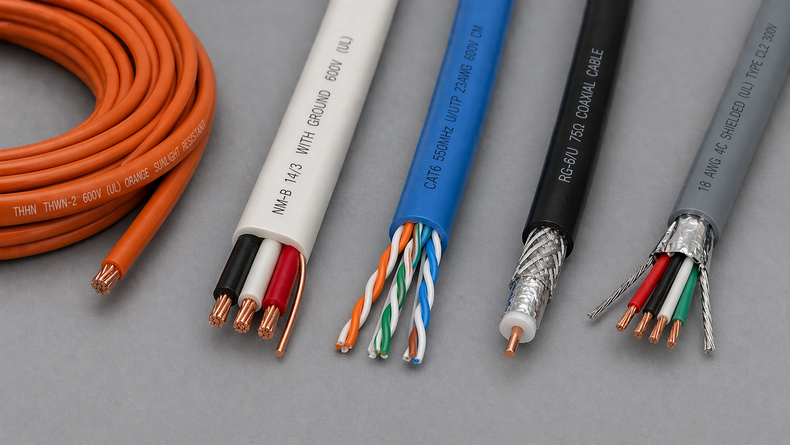
Electrical cable is organized into broad categories defined by function. The main types of electrical cable are power cable, which carries electrical energy from a source to a load; control cable, which carries signals for automation and instrumentation; communication cable, which carries data and voice; and coaxial cable, which carries radio-frequency and broadband signals along a concentric construction. A fifth grouping — specialty cable — covers constructions engineered for specific environments such as fire alarm, marine, high-temperature, and photovoltaic applications.
What Are the Main Types of Electrical Cable?
Cable categories are organized by what the cable carries and how that signal or energy behaves. The types of electrical cable explained below share a common set of building blocks — conductor, insulation, optional shielding, and jacket — but differ in how those elements are combined. Power cable construction prioritizes conductor size, insulation voltage rating, and ampacity. Control cable construction prioritizes multi-conductor packaging and signal integrity. Communication cable construction prioritizes bandwidth, impedance, and cross-talk rejection. Coaxial cable construction prioritizes a controlled-impedance concentric geometry for high-frequency performance.
Categories overlap at the edges. Control cable is sometimes described as a form of low-voltage power-limited cable. Coaxial cable carries communication signals but is typically treated as its own family because of its distinctive construction. Specialty cable is a catch-all for assemblies whose application — not their signal type — defines the product.
These categories build on the structural difference between wire and cable: a single-conductor wire is one building block, and most of the cable types below are multi-conductor assemblies that combine conductors, insulation, optional shielding, and a jacket to serve a specific role.
Power Cable
Power cable is engineered to carry electrical energy from a source to a load. Its construction emphasizes conductor cross-section (expressed in AWG or kcmil), insulation voltage rating, thermal rating, and jacket robustness for the installation environment.
Power cable is commonly grouped into three broad voltage classes:
- Low-voltage power cable. Building wire, residential and commercial branch circuit cable, and portable cords. Typical designations include THHN, THWN-2, XHHW-2, NM-B, MC, AC, UF, SE, SER, USE-2, SOOW, and SJOOW.
- Medium-voltage power cable. Distribution cable for industrial facilities, underground residential distribution (URD), and utility feeder applications. Typical designations include MV-90 and MV-105, along with concentric-neutral constructions used in URD installations.
- High-voltage power cable. Transmission and sub-transmission cable used by utilities and heavy industrial sites. Constructions commonly use cross-linked polyethylene (XLPE) or ethylene-propylene rubber (EPR) insulation, often with corrugated metallic sheaths.
Within each voltage class, power cable may be single-conductor or multi-conductor, jacketed or unjacketed, armored or unarmored. Portable cord (SOOW, SJOOW, and similar) is a subcategory of low-voltage power cable engineered for repeated flexing.
Control Cable
Control cable carries signals — not bulk power — between a controller and a field device. Typical applications include motor-starter wiring, programmable-logic-controller (PLC) input and output, instrumentation feedback, and automation networks. Conductor counts are generally higher than in power cable (four, seven, twelve, or more), and individual conductor size is smaller because current flow is low.
Common control cable types include:
- Tray cable (TC, TC-ER). Multi-conductor cable designed for installation in cable trays, conduit, and raceways, with TC-ER additionally permitted in specific exposed-run applications between cable tray and field device.
- Power-limited tray cable (PLTC). Lower-voltage tray cable intended for power-limited control circuits.
- Instrumentation tray cable (ITC). Shielded tray cable for low-energy instrumentation signals in industrial settings.
- Variable-frequency-drive cable (VFD). Shielded, symmetrically constructed cable engineered for the high-frequency switching output of motor drives. Its shield geometry is designed to contain electromagnetic emissions from the drive.
Shielding is common in control cable. It may be foil, braid, or a combination, and is selected based on the electromagnetic environment the cable operates in — see shielded vs unshielded cable for a detailed comparison.
Communication Cable
Communication cable carries data, voice, and low-level analog or digital signals. The broad subcategories are twisted-pair data cable, fiber optic cable, and legacy telephone and low-voltage signal cable.
- Twisted-pair data cable. Category 5e, Category 6, Category 6A, Category 7, and Category 8 cable for Ethernet and similar networks. Constructions differ in pair count, pair twist rate, separator construction, and shielding scheme.
- Fiber optic cable. Single-mode or multi-mode optical fiber, commonly used where bandwidth, immunity to electromagnetic interference, or long-distance performance is required.
- Telephone and station wire. Unshielded multi-pair cable used for voice circuits and legacy PBX installations.
- Audio and low-voltage signal cable. Speaker cable, thermostat wire, doorbell wire, and similar low-energy signal cable used in residential and commercial installations.
Communication cable in North America is commonly specified with a fire-performance rating appropriate to the installation space. Plenum vs riser cable ratings — CMP, CMR, and CM for general-purpose communication cable — identify which assemblies are permitted in return-air plenums, vertical riser shafts, and general-purpose spaces.
Coaxial Cable
Coaxial cable is a specialized form of communication cable built around a concentric geometry: a center conductor, a surrounding dielectric insulator, a cylindrical shield, and an outer jacket, all sharing a common axis. That geometry produces a controlled characteristic impedance, which is necessary for clean radio-frequency and high-bandwidth transmission.
Coaxial cable is commonly specified by its characteristic impedance. 75-ohm coaxial cable is widely used for video, broadband internet, and CATV distribution; typical designations include RG-6, RG-11, and RG-59. 50-ohm coaxial cable is commonly used for two-way radio, cellular, wireless infrastructure, and laboratory instrumentation; typical designations include RG-58, RG-8, and low-loss LMR-style cable.
Hardline coaxial cable uses a rigid or semi-rigid metallic outer conductor in place of a braid and is used for long runs, high-power RF, and broadcast-feeder applications where signal loss and shielding performance are critical.
Specialty Cable
Specialty cable covers constructions whose application defines the product, rather than a broad signal category. Common specialty cable families include:
- Fire-alarm cable. FPL, FPLR, and FPLP designations for general-purpose, riser, and plenum fire-alarm circuits.
- Marine cable. Constructions rated for salt exposure, moisture, and flex cycles aboard vessels.
- Photovoltaic (PV) cable. Sunlight-resistant, wet-rated cable engineered for solar-array interconnects, typically with XLPE or similar insulation.
- High-temperature cable. Constructions using PFA, FEP, ETFE, silicone, or fiberglass insulation for elevated-temperature environments such as furnaces, ovens, motor leads, and heating elements.
- Medical-grade cable. Hospital-grade cord and low-leakage cable assemblies for medical equipment.
- Tracer (locator) wire. Single-conductor wire installed alongside non-metallic underground infrastructure so the run can later be located with an electromagnetic tracer.
- Armored cable. Metal-clad (MC), armored (AC), and teck-style constructions with interlocked metal tape or continuously corrugated aluminum armor for mechanical protection.
Specialty cable construction often hinges on the jacket and conductor insulation selected for the environment. Common cable insulation materials — PVC, XLPE, LSZH, PE, and others — determine thermal, chemical, and mechanical tolerance and are frequently the deciding factor in which specialty assembly is used where.
How the Main Categories Compare
| Category | Primary function | Typical construction | Representative designations |
|---|---|---|---|
| Power | Transmit electrical energy | Single or multi-conductor, jacketed, voltage-rated | THHN, NM-B, MC, SE, MV-90, SOOW |
| Control | Carry automation and instrumentation signals | Multi-conductor, frequently shielded | TC-ER, PLTC, ITC, VFD |
| Communication | Carry data, voice, and low-level signals | Twisted pairs or optical fiber, fire-rated jacket | Cat5e/6/6A, fiber optic, station wire |
| Coaxial | Carry RF and broadband signals | Concentric: center conductor, dielectric, shield | RG-6, RG-59, RG-11, RG-58, hardline |
| Specialty | Application-specific (fire, marine, PV, high-temp) | Varies by application | FPLR, PV wire, marine cable, teck, silicone lead wire |
Key Takeaways
- Types of electrical wire and cable are organized around function: power, control, communication, coaxial, and specialty categories.
- Power cable is subdivided by voltage class (low, medium, high) and by construction form (single-conductor, jacketed multi-conductor, portable).
- Control cable is multi-conductor and frequently shielded, carrying automation and instrumentation signals rather than bulk energy.
- Communication cable covers twisted-pair data cable, fiber optic cable, and legacy telephone and low-voltage signal cable, with fire-performance ratings tied to the installation space.
- Coaxial cable is treated as its own category because its concentric construction is engineered for controlled-impedance RF and broadband performance.
- Specialty cable covers constructions designed for specific environments such as fire alarm, marine, photovoltaic, high-temperature, and medical applications.
Frequently Asked Questions
What are the main types of electrical cable?
The main types of electrical cable are power cable, control cable, communication cable, coaxial cable, and specialty cable. Power cable carries electrical energy from a source to a load. Control cable carries signals for automation and instrumentation. Communication cable carries data and voice. Coaxial cable carries radio-frequency and broadband signals. Specialty cable covers constructions engineered for specific environments or applications.
What is the difference between power, control, and communication cable?
Power cable is built to carry electrical energy; its construction is organized around conductor size, insulation voltage rating, and ampacity. Control cable carries low-energy signals for automation, motor control, or instrumentation, and is typically multi-conductor with optional shielding. Communication cable carries data, voice, or low-level signals, and is engineered around signal integrity, impedance, and cross-talk rejection rather than current-carrying capacity.
Is coaxial cable a form of communication cable?
Coaxial cable carries communication signals, but it is commonly treated as its own category because of its distinctive concentric construction. A coaxial cable's center conductor, dielectric, and outer shield share a common axis, and that geometry produces a controlled characteristic impedance essential for radio-frequency and broadband performance.
What cable is used for data networks?
Data networks most commonly use twisted-pair cable in Category 5e, Category 6, Category 6A, Category 7, or Category 8 construction, or fiber optic cable for higher-bandwidth or longer-distance runs. Both sit within the broader communication cable category.
What is specialty cable?
Specialty cable is a grouping of constructions designed for specific applications or environments that do not fit neatly into the power, control, communication, or coaxial categories. Fire-alarm cable, marine cable, photovoltaic (PV) cable, variable-frequency-drive (VFD) cable, and high-temperature cable are common examples.
Related reading on Ongauge: difference between wire and cable, plenum vs riser cable ratings, shielded vs unshielded cable, and common cable insulation materials and their properties.