 Free Shipping $1,000+

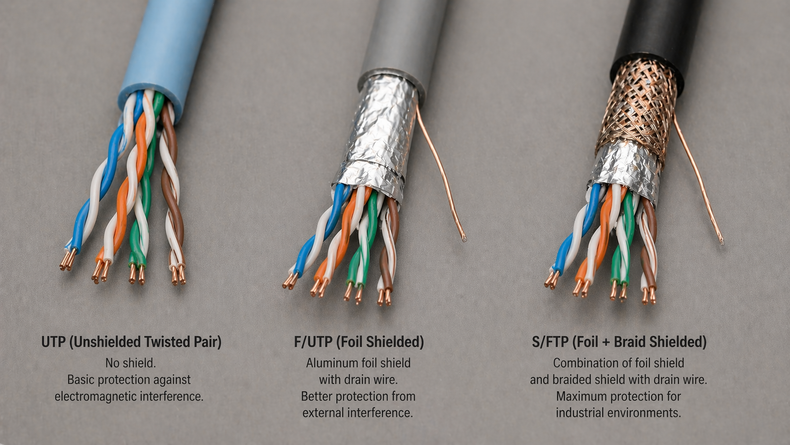
Shielded vs unshielded cable refers to whether a cable contains a conductive layer wrapped around its conductors to reject electromagnetic interference (EMI) and contain internal signal emissions. Shielded cable adds a metal foil, a braided mesh, or both over the conductor core. Unshielded cable omits that layer and relies on its jacket, conductor construction, and installation environment for signal integrity. Shielded construction is common in industrial control wiring, instrumentation, audio cable, and data cable installed near motors, drives, or high-power equipment. Unshielded cable is common in low-noise environments where EMI is not a design concern and where the lower cost and easier termination of unshielded construction outweigh the marginal shielding benefit.
What a Cable Shield Does
A cable shield is a conductive layer placed between the conductors and the outer jacket — typically aluminum foil, a woven copper braid, or a combination. It provides a controlled path for electromagnetic energy that would otherwise couple into or out of the signal conductors.
Shielding addresses two distinct failure modes:
- Ingress. External EMI — from motor windings, variable-frequency drives, welders, switch-mode power supplies, radio transmitters, or adjacent power cable — coupling into the signal conductors and corrupting the signal.
- Egress. Signals on the conductors radiating outward as electromagnetic emissions, which can disturb nearby equipment or exceed regulatory limits for emissions.
Shielding is one of several EMI-mitigation strategies. Twisted-pair construction, balanced (differential) signaling, careful cable routing, and physical separation from noise sources all contribute to signal integrity alongside shielding. The specific combination chosen depends on the electromagnetic environment, signal characteristics, and cost targets for the installation.
Types of Cable Shielding
EMI shielding in cables is implemented through a handful of standard constructions, each with its own frequency-response characteristics, mechanical behavior, and cost.
Foil Shield
A foil shield is a thin metallic film — commonly aluminum bonded to a polyester carrier — wrapped helically or longitudinally around the conductor core. Foil shields provide full (100%) coverage of the underlying conductors and perform well at higher frequencies. Foil alone has relatively high resistance and is physically delicate, so a bare copper drain wire is typically included in contact with the foil to provide a low-resistance path for termination.
Braid Shield
A braid shield is a woven mesh of fine metallic strands, most commonly tinned copper. Coverage is typically 65% to 95% depending on the weave density. Braid has lower DC resistance than foil and performs better at low to mid frequencies. Because the braid itself is a robust conductor, it can be terminated directly to a connector backshell or grounding point without a dedicated drain wire.
Foil and Braid (Composite) Shield
A composite shield combines a foil layer (for high-frequency coverage) with a braid layer (for low-frequency coverage and mechanical robustness). Composite shielding is common in variable-frequency-drive cable, Category 7 and higher data cable, broadcast audio cable, and medical cable where broadband EMI rejection is required.
Spiral (Served) Shield
A spiral shield wraps individual metallic strands helically around the conductor core in a single direction. Coverage can approach 100%, but the spiral geometry creates a small inductance along the cable length that reduces high-frequency shielding performance compared with braid. Spiral shields are common in high-flex portable applications where the repeated mechanical cycling of a braid would fatigue the strands.
Shield Construction at a Glance
| Construction | Coverage | Best frequency range | Typical applications |
|---|---|---|---|
| Foil | 100% | High frequency | Data cable, low-cost instrumentation |
| Braid | 65-95% | Low to mid frequency | Control cable, audio, portable cord |
| Foil + braid (composite) | Effectively full | Broadband | VFD cable, Category 7+ data cable, medical |
| Spiral (served) | Near full | Low to mid frequency | High-flex portable applications |
Unshielded Cable Applications
Unshielded cable covers the broad majority of installed cable worldwide. Most power cable, most twisted-pair Ethernet cable (UTP), and most residential and light-commercial signal cable is unshielded. Unshielded construction is less expensive, terminates faster, has a smaller bend radius, and weighs less than a comparable shielded cable.
In twisted-pair cable, the twist itself provides a measure of EMI rejection: noise coupled into both conductors of a pair tends to be common-mode, and balanced differential receivers reject common-mode signal components. For many office, residential, and light-commercial installations, twisted-pair construction alone provides adequate EMI performance without a shield. Shielded alternatives are specified when the installation environment exceeds what twisted-pair construction alone can handle — or when the application covers a broader range of types of electrical wire and cable with different EMI profiles.
Industry Naming Conventions (UTP, STP, F/UTP, S/FTP)
ISO/IEC 11801 defines a shorthand for describing the shielding scheme of twisted-pair cable. The code takes the form XX/YTP, where the first pair of letters describes any shielding applied to the overall cable and the second letter describes any shielding applied to each individual pair.
- U — unshielded
- F — foil shield
- S — braid shield
- SF — braid over foil (composite)
Common examples:
- UTP (U/UTP): unshielded twisted pair — no shielding at either level.
- F/UTP: overall foil shield, unshielded pairs. Common in Category 6A installations in elevated-EMI environments.
- U/FTP: unshielded overall, foil shield around each pair. Common in Category 6A and above where pair-to-pair cross-talk is the primary concern.
- S/FTP: overall braid shield plus a foil shield around each pair. Used in Category 7 and 8 cable and in high-EMI industrial and medical installations.
- SF/UTP: overall braid over foil, unshielded pairs.
The earlier generic term STP (shielded twisted pair) is still in wide use but does not specify which shielding scheme is applied. Modern specifications typically use the ISO/IEC 11801 code instead.
Shield Termination and Grounding
A shield attenuates EMI only when it is terminated to a reference ground. An unterminated or floating shield provides little to no practical attenuation.
Two common grounding schemes are used:
- Single-ended grounding. The shield is bonded to ground at one end only — typically the source end or the instrument end. Single-ended grounding avoids ground-loop currents that can develop when two physically separated ground points sit at different potentials. It is commonly applied at low frequencies, such as in audio and instrumentation cable.
- Double-ended grounding. The shield is bonded to ground at both ends of the run. Double-ended grounding provides better high-frequency shielding performance, because the shield forms a closed loop around the signal path, but it can admit ground-loop currents if the two ground references are not at the same potential.
Termination geometry also matters. A 360-degree termination — in which the shield is bonded around its full circumference at the connector backshell — performs better at high frequencies than a pigtail termination, in which the shield is gathered into a short lead that introduces inductance at the termination point. Shielded installations in direct burial and conduit wiring methods introduce additional grounding and bonding considerations, because the conduit or armor can serve as an additional conductive path that interacts with the cable shield.
Key Takeaways
- A cable shield is a conductive layer that rejects external EMI and contains internal signal emissions; unshielded cable omits that layer.
- Foil shields give full coverage and perform well at high frequencies; braid shields offer lower resistance, better low-frequency performance, and mechanical durability.
- Composite (foil + braid) shields combine the two and are common in VFD, high-category data, and medical cable.
- Twisted-pair construction contributes to EMI rejection independently of any shield; UTP cable is the standard in low-noise commercial and residential installations.
- Industry shorthand (U/UTP, F/UTP, U/FTP, S/FTP, SF/UTP) describes which shielding is applied at the overall cable level and at each individual pair.
- Shield performance depends on proper termination; an ungrounded shield does not meaningfully attenuate EMI.
Frequently Asked Questions
In what environments is shielded cable specified?
Shielded cable is commonly specified in industrial environments with motors, welders, or variable-frequency drives, in installations where the signal cable runs near power cable, and in applications subject to electromagnetic compatibility (EMC) regulations. Sensitive low-level signal applications — instrumentation, medical electronics, audio recording, and broadcast — also frequently specify shielded construction.
What is the difference between foil and braid shielding?
Foil shielding uses a thin metallic film (typically aluminum on a polyester carrier) with full coverage of the conductor core; it performs well at higher frequencies and is usually terminated via a drain wire because the foil itself has high resistance. Braid shielding uses a woven mesh of metallic strands with coverage typically between 65% and 95%; it has lower resistance, performs better at low to mid frequencies, tolerates repeated flexing better than foil, and can be terminated directly.
Does shielded cable need to be grounded?
A shield only performs its EMI-attenuation function when it is terminated to a reference ground. An ungrounded or floating shield has limited practical effect. Whether the shield is grounded at one end or both depends on the frequency range of the interference and the ground-loop behavior of the installation.
Is STP better than UTP?
STP (shielded twisted pair) is not universally better than UTP (unshielded twisted pair); each is engineered for different environments. UTP relies on the precise twist of each conductor pair to reject common-mode noise and is widely used for Ethernet in office and commercial installations where ambient EMI is low. STP adds a shield layer and is specified where the installation environment has elevated EMI or where regulatory emissions limits apply.
What is the difference between UTP, F/UTP, and S/FTP cable?
UTP (or U/UTP) is fully unshielded twisted-pair cable. F/UTP places a foil shield over all the pairs together, leaving the individual pairs unshielded. S/FTP combines an overall braided shield with a foil shield around each individual pair. The naming follows ISO/IEC 11801: the first letters describe any shielding at the overall cable level; the letter before TP describes any shielding at the individual pair level.
Related reading on Ongauge: difference between wire and cable, types of electrical wire and cable explained, and direct burial and conduit wiring methods.