 Free Shipping $1,000+

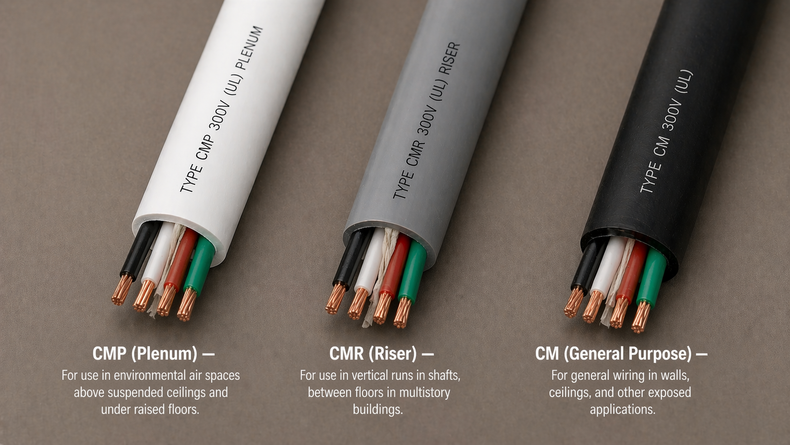
The distinction between plenum vs riser cable is a core element of cable specification, and includes a third general-purpose tier that completes the hierarchy. Plenum (CMP), riser (CMR), and general-purpose (CM) are the three fire-performance ratings that determine where communications cable can be installed in a building. Plenum-rated cable is designed for return-air plenum spaces and is tested for low flame spread and low smoke emission. Riser-rated cable is designed for vertical shafts that connect floors and is tested to resist flame propagation between levels. General-purpose cable is rated for installations outside plenums and risers. Higher ratings substitute downward for lower ratings, but not the reverse.
What Do Plenum, Riser, and General-Purpose Cable Ratings Mean?
The three ratings describe the fire performance of a cable's jacket and insulation under standardized flame tests. Each rating corresponds to a specific installation environment defined by the National Electrical Code (NEC). The shorthand CMP vs CMR vs CM captures the three tiers for communications cable, with letter codes drawn from the NEC's type designations. Similar tiered codes exist for other cable families: FPLP/FPLR/FPL for fire-alarm cable, CL2P/CL2R/CL2 and CL3P/CL3R/CL3 for Class 2 and Class 3 power-limited cable, MPP/MPR/MP for multipurpose cable, and OFNP/OFNR/OFN for nonconductive optical fiber cable.
Across all of these families, the suffix letter signals the fire test classification: a trailing P for plenum, a trailing R for riser, and no suffix for general-purpose. The tiered structure, along with other cable markings, sits within the broader framework of electrical cable codes and classifications used to specify cable for a given installation space.
Plenum Cable (CMP)
In building terminology, a plenum is a space that forms part of the air-handling system. Most commonly this is the space above a drop ceiling or below a raised floor that carries return air back to the HVAC equipment. Plenum cable is cable permitted to run through these spaces without conduit, because its jacket and insulation are engineered to minimize flame spread and smoke emission in a fire event.
Plenum cable must pass the fire-performance test defined in NFPA 262 (historically also designated UL 910). The test is conducted in a Steiner tunnel apparatus: a horizontal sample of cable is exposed to a defined burner flame, and the test measures both how far flame travels along the cable and the optical density of smoke produced during combustion.
To meet NFPA 262 requirements, plenum cable commonly uses fluoropolymer materials — fluorinated ethylene propylene (FEP) is frequently used for conductor insulation, and plenum-rated PVC or low-smoke zero-halogen (LSZH) formulations are common jacket compounds. The fire-test demands drive the material selection, and the material choice is the primary reason plenum cable carries a higher cost than riser or general-purpose equivalents at the same conductor construction. For more detail on how these compounds differ, see common cable insulation materials and their properties.
Riser Cable (CMR)
Riser refers to a vertical shaft that connects floors in a building — an elevator shaft, a utility chase, or a dedicated cable riser. The primary fire-safety concern in a riser is vertical flame propagation from one floor to the next.
Riser cable must pass UL 1666, a vertical flame test that evaluates a cable's ability to resist floor-to-floor flame propagation. The test setup mounts a sample cable vertically in a defined shaft and applies an ignition source; pass criteria relate to the height flame travels before self-extinguishing.
Riser cable jackets are commonly PVC formulations designed to self-extinguish once the ignition source is removed. Riser cable does not carry the low-smoke requirements that plenum cable must meet, so it typically costs less to manufacture than a comparable plenum cable.
General-Purpose Cable (CM)
General-purpose cable covers installations that are neither in a plenum nor in a riser — horizontal runs within a single floor, runs in residential spaces that do not require higher ratings, and commercial applications that do not traverse return-air plenums or vertical shafts.
General-purpose communications cable is tested to a vertical flame test that is less stringent than either NFPA 262 or UL 1666. The pass criteria ensure the cable will not readily propagate flame when exposed to a small ignition source. The exact test method varies by cable category and applicable product standard.
Because general-purpose cable uses the least-stringent fire-performance tier, jacket compound choice is broader and less costly — standard PVC is typical. At a given conductor construction, general-purpose cable is the least expensive of the three tiers.
Construction Summary
| Rating | Letter code | Applicable fire test | Typical construction notes |
|---|---|---|---|
| Plenum | CMP | NFPA 262 / UL 910 | Low-smoke jacket; fluoropolymer (FEP) conductor insulation common |
| Riser | CMR | UL 1666 | Self-extinguishing PVC jacket common |
| General-purpose | CM | Less stringent vertical flame test | Standard PVC jacket and insulation common |
Substitution Rules
The NEC permits higher-rated cable to be installed in place of lower-rated cable, but not the reverse. A plenum-rated cable contains the materials and construction needed to pass the riser and general-purpose tests as well, so it is acceptable anywhere a lower-rated cable would go. A general-purpose cable does not meet the higher-tier fire tests and cannot be installed in a riser or a plenum.
| If the installation space requires... | ...these ratings are acceptable |
|---|---|
| Plenum | CMP only |
| Riser | CMP or CMR |
| General-purpose | CMP, CMR, or CM |
The same substitution pattern applies to the related cable families (FPLP/FPLR/FPL, CL2P/CL2R/CL2, CL3P/CL3R/CL3, MPP/MPR/MP, and OFNP/OFNR/OFN). Within each family, the P-suffix cable can substitute for the R-suffix cable, and the R-suffix cable can substitute for the unsuffixed cable. Substitution across families (for example, using a fire-alarm cable in place of a communications cable) is governed by additional NEC rules beyond the plenum/riser/general-purpose hierarchy.
Why These Ratings Exist
Cable installed without conduit can contribute smoke and toxic gases to a structure fire. In a return-air plenum, a burning cable can distribute smoke through the HVAC system into occupied spaces. In a riser, a burning cable can act as a vertical wick that propagates flame between floors. Plenum and riser ratings were developed so that the fire load of a cable run matches the fire-safety demands of the installation space, while general-purpose cable provides a lower-cost option for environments where neither concern applies. Shielded plenum and riser cable constructions are also available, and the shield configuration does not change the fire-rating test; see shielded vs unshielded cable for construction detail.
Key Takeaways
- Plenum (CMP), riser (CMR), and general-purpose (CM) are the three fire-performance ratings for communications cable, corresponding to return-air plenum, vertical-shaft, and general-use installations.
- Plenum cable passes NFPA 262 / UL 910; riser cable passes UL 1666; general-purpose cable passes a less stringent vertical flame test.
- Plenum cable typically uses fluoropolymer conductor insulation and low-smoke jackets; riser cable uses self-extinguishing PVC jackets; general-purpose cable uses standard PVC.
- Higher-rated cable can substitute for lower-rated cable (CMP → CMR → CM), but lower-rated cable cannot substitute upward.
- The same plenum/riser/general-purpose structure applies to other NEC cable families: fire alarm (FPLP/FPLR/FPL), Class 2 and 3 power-limited (CL2/CL3 with P and R suffixes), multipurpose (MPP/MPR/MP), and optical fiber (OFNP/OFNR/OFN).
Frequently Asked Questions
What is the difference between plenum and riser cable?
Plenum cable (CMP) is rated for installation in return-air plenum spaces and passes NFPA 262 / UL 910, a horizontal burn test measuring both flame travel distance and smoke density. Riser cable (CMR) is rated for installation in vertical shafts connecting floors and passes UL 1666, a vertical flame test measuring resistance to floor-to-floor flame propagation. Plenum cable typically uses fluoropolymer materials and low-smoke jackets; riser cable typically uses self-extinguishing PVC.
Can riser cable be installed in a plenum?
Riser cable is not rated for installation in a plenum space. The NEC permits higher-rated cable to substitute downward — plenum cable can be installed in a riser — but it does not permit riser cable to substitute upward into a plenum.
Where is plenum cable required by code?
Plenum cable is required by the National Electrical Code wherever applicable cable categories are installed in a space used as a return-air plenum. Whether a specific space qualifies as a plenum is a determination made by the building designer and local authority having jurisdiction; the cable rating requirement follows from that determination.
What do the letters CMP, CMR, and CM mean?
CMP, CMR, and CM are NEC-defined type designations for communications cable. CM is the base designation for general-purpose communications cable. CMR indicates riser-rated communications cable. CMP indicates plenum-rated communications cable. The suffix letter (P for plenum, R for riser, or no suffix for general-purpose) identifies the fire-performance tier applied to the cable's jacket and insulation.
Can general-purpose cable be used in a riser or plenum?
General-purpose cable (CM) is not rated for riser or plenum installation. The NEC permits higher-rated cable to substitute downward — CMP can be installed in a riser or general-purpose space, and CMR can be installed in a general-purpose space — but general-purpose cable cannot substitute upward into a riser or plenum environment.
Related reading on Ongauge: difference between wire and cable, shielded vs unshielded cable, common cable insulation materials and their properties, and electrical cable codes and classifications.