 Free Shipping $1,000+

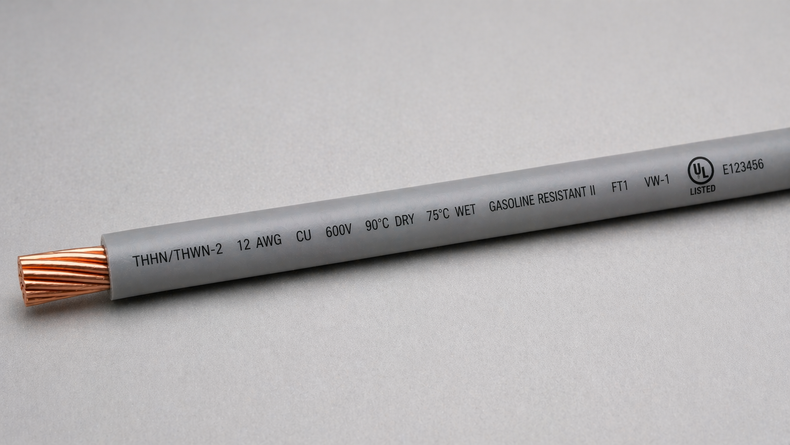
Electrical cable codes and classifications define what a cable is, how it is tested, and where it may be installed. In North America, the National Electrical Code (NEC) governs installation requirements, and Nationally Recognized Testing Laboratories (NRTLs) such as UL certify that specific products meet the applicable construction and performance standards. Cable type designations — CMP, CMR, THHN, XHHW-2, MV-90, and similar — encode the cable's construction, temperature rating, voltage rating, and environment-specific performance in a short alphanumeric marking printed on the jacket.
What Governs Cable Classification
Cable classification in the United States sits at the intersection of three overlapping systems:
- Installation codes set by the NEC (NFPA 70) and adopted by state or local jurisdictions. The NEC defines where each cable type may be installed, how it must be supported, and what electrical conditions it serves.
- Product safety standards developed by UL, CSA, and other NRTLs. These standards define the construction and testing a cable must meet to bear the laboratory's mark.
- Industry construction and performance standards published by ICEA, AEIC, NEMA, and IEEE. These define cable anatomy, performance testing, and field procedures that sit above the UL product-safety level.
A cable in service typically references all three layers at once: the NEC determines where it may be installed, a UL or equivalent NRTL Listing confirms it has been tested to the relevant product standard, and ICEA or AEIC standards cover construction detail and field testing beyond what the UL standard addresses.
The National Electrical Code (NEC)
The NEC — NFPA 70 — is published by the National Fire Protection Association on a three-year revision cycle. It is adopted, with or without local amendments, by states, counties, and municipalities across the United States. The NEC is not itself law; it becomes law when a jurisdiction adopts it, at which point the edition the jurisdiction adopted governs local installations until the next adoption.
The NEC organizes cable-related requirements across several chapters. Chapter 3 covers wiring methods and materials, including the installation rules for each common cable type (NM, MC, AC, UF, SE, and others). Chapter 8 addresses communications circuits and cable ratings such as CMP, CMR, and CM. Chapter 9 contains the cable-sizing and raceway-fill tables that translate design loads into conductor sizes and conduit dimensions. Article 310 covers conductor ampacity for building wire.
Because the NEC is adopted on a three-year cycle and many jurisdictions adopt older editions, the specific article numbers and table references may differ between installations. The categories and principles remain consistent across editions; the numbering shifts from one revision to the next.
Testing Laboratories and NRTL Listing
A Nationally Recognized Testing Laboratory, or NRTL, is a laboratory recognized by the U.S. Occupational Safety and Health Administration (OSHA) as qualified to test and certify products against consensus safety standards. UL is the most widely known NRTL for cable and is often used as shorthand for \"cable certification,\" though several other NRTLs are equally recognized, including CSA (Canadian Standards Association), Intertek (ETL mark), MET Laboratories, and FM Approvals.
Cable testing against NRTL standards covers construction (materials, dimensions, conductor makeup), electrical performance (insulation resistance, dielectric withstand), mechanical performance (cold bend, aging, impact), and environmental performance (fire, smoke, moisture, sunlight). Commonly referenced UL standards for cable include:
- UL 83 — thermoplastic-insulated wires and cables (THHN, THWN-2, and similar).
- UL 44 — thermoset-insulated wires and cables (XHHW-2, RHW-2, USE-2, and similar).
- UL 1569 — metal-clad (MC) cable.
- UL 1685 — vertical-tray fire-propagation and smoke-release test used in cable tray assemblies.
- UL 1666 — vertical flame propagation test used for riser-rated cable (CMR, CL2R, FPLR, OFNR).
- UL 910 / NFPA 262 — horizontal Steiner tunnel fire and smoke test used for plenum-rated cable (CMP, CL2P, FPLP, OFNP).
Reading a Cable Marking
A cable's jacket marking is a condensed record of the applicable standards and specifications. A typical marking for a low-voltage building wire contains the type designation, conductor size, insulation compound, temperature rating, voltage rating, fire-performance marking, manufacturer identification, and NRTL mark.
| Marking element | Meaning | Example |
|---|---|---|
| Type designation | NEC-defined cable type governing where it may be installed | THHN, XHHW-2, MC, NM-B, MV-90, CMP |
| Conductor size | AWG or kcmil, with stranding shown as solid or Class B/C | 12 AWG, 500 kcmil |
| Insulation compound | Material printed on the jacket or implied by type designation | PVC, XLPE, EPR, silicone |
| Temperature rating | Maximum continuous conductor temperature in °C | 60°C, 75°C, 90°C |
| Voltage rating | Insulation operating voltage | 600V, 1 kV, 15 kV |
| Fire / environment rating | Installation-space rating such as plenum, riser, or direct burial | CMP, CMR, sunlight-resistant, direct-burial |
| Manufacturer identification | Name or code identifying the producer | Manufacturer name, logo, or code |
| NRTL mark | Symbol identifying the laboratory that Listed the product | UL, cUL, ETL, CSA |
Environment-specific markings such as CMP and CMR link to the separate framework for plenum vs riser cable ratings, which cover the fire-performance tiers printed alongside the type designation.
NEC Terminology: Listed, Labeled, Approved, Identified
The NEC uses a precise vocabulary when referring to products and approvals. Four terms in particular carry specific meanings:
- Approved. Acceptable to the authority having jurisdiction (AHJ) — the state inspector, municipal electrical inspector, or equivalent. \"Approved\" is a statement of local acceptance, not a statement about laboratory testing.
- Listed. The product has been evaluated by an NRTL, found to meet appropriate designated standards, and appears on the NRTL's published list.
- Labeled. The product bears a symbol or other identifying mark from an NRTL that identifies it as Listed.
- Identified. Suitable for the specific purpose, function, use, environment, application, and so forth, based on evaluation by a qualified source (which may include, but is not limited to, an NRTL).
The distinction matters during inspection. A cable that is Listed and Labeled by an NRTL has been third-party-tested; a cable that is merely \"Approved\" by an AHJ has been accepted by the local inspector but may or may not carry laboratory certification.
Related Standards Bodies
Beyond the NEC and the NRTLs, several organizations publish standards that shape cable construction and testing:
- ICEA (Insulated Cable Engineers Association). Publishes cable construction standards, particularly for medium-voltage power cable. ICEA standards address conductor stranding, insulation thickness, shield construction, and similar detail that sits below the NEC's installation-level scope.
- AEIC (Association of Edison Illuminating Companies). Publishes cable performance and testing specifications adopted by many utility purchasers, particularly for medium-voltage and high-voltage distribution cable.
- NEMA (National Electrical Manufacturers Association). Publishes wire and cable product standards (the WC-series among others) that align manufacturing practice across producers.
- IEEE (Institute of Electrical and Electronics Engineers). Publishes testing and field-procedure standards, including specifications for cable field testing and partial-discharge evaluation.
- IEC (International Electrotechnical Commission). Publishes international standards for conductors, insulation systems, and power cable construction. IEC standards dominate in European, Asian, and international-project specifications and occasionally appear in dual-listed product markings.
Cable classification is ultimately a materials question: the insulation compound, conductor geometry, and jacket composition determine which standards a cable can satisfy. A detailed look at the compounds that map to each classification appears in common cable insulation materials and their properties, and the voltage side of the same classification picture is covered in electrical cable voltage ratings.
Key Takeaways
- Electrical cable codes and classifications sit at the intersection of installation codes (NEC), product safety standards (UL and other NRTLs), and industry construction and performance standards (ICEA, AEIC, NEMA, IEEE, IEC).
- The NEC (NFPA 70) is revised on a three-year cycle; adopted editions vary by jurisdiction, so specific article numbers may differ from one installation to the next.
- UL is one of several NRTLs that test and Certify cable; others include CSA, ETL (Intertek), MET, and FM.
- Cable jacket markings encode type designation, conductor size, insulation, temperature rating, voltage rating, fire or environment rating, manufacturer, and NRTL mark.
- The NEC uses distinct terms for Approved, Listed, Labeled, and Identified; each carries a specific meaning that affects inspection and compliance.
- Environment-specific markings (CMP, CMR, direct-burial, sunlight-resistant) are layered on top of the base NEC type designation.
Frequently Asked Questions
What do NEC cable classifications mean?
NEC cable classifications are the type designations — CMP, CMR, CM, FPLP, FPLR, FPL, THHN, THWN-2, XHHW-2, MV-90, NM-B, MC, AC, UF, SE, and others — that identify a cable's construction, insulation system, and permitted installation environments. Each designation corresponds to a specific set of requirements in the NEC covering where the cable may be installed, how it must be supported, and what other electrical conditions it can serve.
What is the difference between UL and NEC?
UL is a product testing and certification laboratory; the NEC is an installation code. UL evaluates cable against construction and performance standards (UL 83, UL 44, UL 1666, UL 910, and others) and Lists products that meet those standards. The NEC specifies where UL-Listed or equivalently-certified cable may be installed and under what conditions. A cable is typically Listed by UL (or another NRTL) and then installed according to the NEC.
What does \"Listed\" versus \"Approved\" mean on a cable?
\"Listed\" means the cable has been evaluated by a Nationally Recognized Testing Laboratory, found to meet appropriate designated standards, and appears on the NRTL's published list. \"Approved\" is an NEC term meaning acceptable to the authority having jurisdiction — the state or local inspector responsible for the installation. A cable can be Listed without being Approved in a given jurisdiction, and vice versa, though Listed products are broadly Approved in most jurisdictions that follow the NEC.
Which cable types are NEC compliant for common installations?
NEC compliance depends on the installation environment. Common building wire in conduit typically uses THHN or THWN-2 (90°C dry and wet respectively) or XHHW-2 (90°C wet and dry). Residential branch circuits commonly use NM-B cable. Commercial and industrial installations often use metal-clad (MC) cable for flexibility with mechanical protection. Plenum communications installations require CMP-rated cable; riser installations require CMR; outdoor direct-burial runs require UF-B, USE-2, or direct-burial-marked cable appropriate to the voltage class. Each of these is NEC-compliant in its intended environment and not interchangeable across environments.
How often is the NEC updated?
The NEC (NFPA 70) is revised on a three-year cycle by the National Fire Protection Association. Each new edition is published, but the edition in force in a specific location depends on when the state or local jurisdiction adopts it. It is common for adopted editions to lag the most recent published edition by one or two cycles, and jurisdictions may adopt the NEC with local amendments that alter specific articles.
Related reading on Ongauge: difference between wire and cable, plenum vs riser cable ratings, common cable insulation materials and their properties, and electrical cable voltage ratings.