 Free Shipping $1,000+

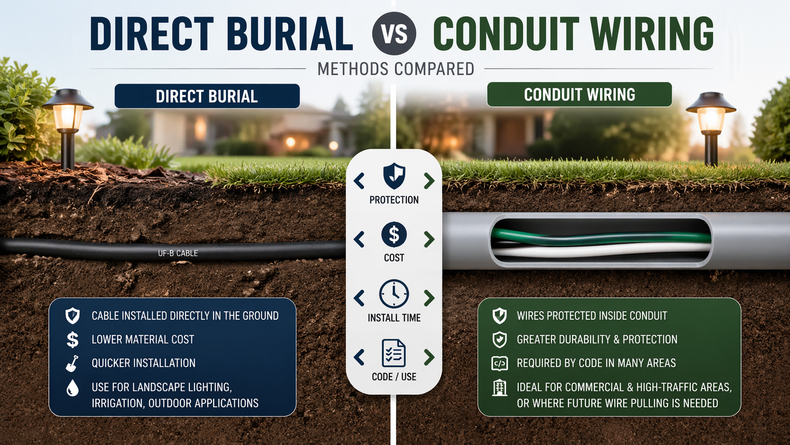
Direct burial vs conduit refers to two distinct approaches to underground wiring. A direct burial installation runs a jacketed, earth-rated cable in a trench without an enclosing raceway, relying on the cable's own construction for protection. A conduit installation pulls wires or cable through a rigid or flexible tube that provides mechanical, environmental, and, in some cases, electrical protection. The two methods handle moisture, mechanical load, and future maintenance differently. Method selection is governed by the cable type, installation depth, soil conditions, and applicable code requirements.
Direct Burial Installation
Direct burial is the installation of a cable directly in the earth, without an enclosing raceway. The cable jacket and insulation do the work that a conduit would otherwise do: resisting moisture, soil chemicals, abrasion, insect and rodent damage, and, at exposed portions, sunlight.
Common direct-burial cable types include:
- UF-B (Underground Feeder and Branch Circuit). A multi-conductor cable with a solid jacket, used for residential and light-commercial branch-circuit feeds to outdoor equipment, detached structures, and landscape lighting.
- USE-2 (Underground Service Entrance). Single-conductor or multi-conductor cable used for service laterals between a utility transformer or meter and the main panel.
- URD (Underground Residential Distribution). Utility-class cable with a concentric-neutral construction, used for underground residential feeders from pad-mounted transformers.
- Direct-burial communications cable. Category 5e, Category 6, coaxial, and fiber-optic cable marked for direct-burial service, with jackets engineered for earth contact and UV exposure at stub-ups.
Installation methods include open trenching, plow-in placement with vibratory equipment, and horizontal directional drilling (HDD) for routes beneath existing infrastructure. The cable jacket materials that make direct burial possible — typically cable insulation materials such as PE, XLPE, and moisture-resistant PVC — are chosen for long-term earth contact and thermal stability.
Conduit Installation
A conduit installation pulls individual conductors, or a cable assembly, through a protective raceway. The conduit provides a continuous mechanical barrier, allows the run to be pulled, replaced, or supplemented later, and, in the case of metallic conduit, can function as an equipment-grounding path.
Common conduit types fall into three groups:
- Rigid metallic conduit. Electrical metallic tubing (EMT), intermediate metal conduit (IMC), and rigid metal conduit (RMC). Each provides progressively heavier-wall steel construction. RMC is the most robust and is commonly used for direct-earth and exposed industrial installations.
- Rigid nonmetallic conduit. PVC conduit in Schedule 40 and Schedule 80 wall thicknesses, and high-density polyethylene (HDPE) conduit used for long directional-bore runs. Schedule 80 PVC carries a heavier wall and is typically used where physical damage is a concern.
- Flexible conduit. Flexible metal conduit (FMC), liquidtight flexible metal conduit (LFMC), and electrical nonmetallic tubing (ENT). Flexible conduit is commonly used for short connections to motors, equipment, and fixtures where vibration, movement, or irregular routing make rigid conduit impractical.
Conductors pulled through conduit are commonly building wire such as THHN, THWN-2, or XHHW-2. A single conduit run may carry multiple circuits, subject to fill-capacity limits defined in the National Electrical Code. Pull tension, bend count, and raceway fill each constrain how many conductors can be installed in a given conduit size.
Direct Burial vs Conduit at a Glance
These two underground electrical wiring methods differ in material cost, mechanical protection, and the effort required to modify or replace the run after installation.
| Attribute | Direct burial | Conduit installation |
|---|---|---|
| Cable or wire used | Earth-rated cable (UF-B, USE-2, URD, direct-burial comm) | Building wire (THHN, THWN-2, XHHW-2) or a cable assembly pulled through the raceway |
| Mechanical protection | From the cable jacket itself | From the conduit |
| Future replacement | Typically requires re-excavation | Pull new conductors through existing conduit |
| Material cost | Lower — no raceway or fittings | Higher — adds conduit, couplings, sweeps, boxes |
| Labor | Trenching and cable laying | Trenching plus conduit assembly plus conductor pull |
| Route modification | Requires excavation at change points | Feasible through existing pull points and junction boxes |
Code Considerations
The National Electrical Code governs both direct burial and conduit installations. Minimum burial depths are set by NEC Article 300 and vary based on the cable type, the presence and type of raceway, the circuit voltage, and the site cover conditions. A residential branch-circuit direct-burial cable, a medium-voltage utility feeder, a cable run beneath a driveway, and a run under a concrete slab are each subject to different minimum depths.
Conduit fill — the number and size of conductors permitted in a given conduit — is governed by tables in Chapter 9 of the NEC. Pull tension, conductor insulation thickness, and the number of bends in the run also affect how many conductors can be installed without risk of insulation damage during the pull.
Installation depth and soil thermal conductivity affect the ampacity of conductors in the ground, because deeper or more thermally resistive installations dissipate heat more slowly. For more on how thermal limits enter cable specification, see temperature ratings in electrical cables.
Nonmetallic conduit and direct-burial installations are often accompanied by a tracer wire — a single-conductor wire buried alongside the cable — so the run can be located later with an electromagnetic locator. Warning tape placed in the trench above the cable or conduit provides a secondary indicator during future excavation.
Hybrid and Combined Installations
Direct burial and conduit installations are frequently combined on a single project. A typical hybrid pattern is a direct-burial cable that enters a conduit sleeve at the point where it transitions out of the ground and into a building, where the raceway protects the cable from mechanical damage and supports the bend geometry required at the entry. Conduit sleeves under driveways, sidewalks, and parking areas protect buried cable at points where future excavation is likely. Above-ground portions of the run may continue through different installation spaces with their own rating requirements — for example, plenum vs riser cable ratings apply in return-air plenums and vertical riser shafts inside the building.
Direct-burial cable placed inside conduit retains its direct-burial rating; the conduit adds mechanical protection but does not change the cable's suitability for earth contact at uncovered portions of the run. Conduit-only installations, by contrast, use building wire that is not rated for direct earth contact and depends on the raceway for environmental protection across the full length of the run.
Key Takeaways
- Direct burial installs an earth-rated cable directly in a trench; conduit installs wire or cable inside a protective raceway.
- Earth-rated cable types for direct burial include UF-B, USE-2, URD, and direct-burial-marked communications cable.
- Conduit types split into rigid metallic (EMT, IMC, RMC), rigid nonmetallic (PVC Schedule 40/80, HDPE), and flexible (FMC, LFMC, ENT).
- The NEC sets burial depth based on cable type, raceway type, voltage, and site cover; it sets conduit fill based on conductor count and insulation.
- Conduit installations typically cost more in material and labor but preserve the ability to replace or add conductors without re-excavation.
- Hybrid installations combining direct-burial cable and conduit sleeves are common at building entries, driveway crossings, and transition points.
Frequently Asked Questions
Can direct burial cable be installed in conduit?
Direct-burial cable can be installed inside conduit and is frequently used that way at points where the cable transitions into a building, crosses a roadway, or passes through an area requiring additional mechanical protection. Placing a direct-burial cable in conduit does not change the cable's direct-burial rating; the cable retains its suitability for earth contact on the uncovered portions of the run.
When is conduit used with direct burial cable?
Conduit is not universally required with direct-burial cable. Cable types rated for direct burial — UF-B, USE-2, URD, and direct-burial communications cable — can be installed in a trench without an enclosing raceway, subject to the minimum burial depths and cover requirements in the National Electrical Code. Conduit is commonly used with direct-burial cable at points where the cable transitions out of the ground, crosses beneath a driveway or parking area, or passes through an area where additional mechanical protection is needed.
How deep does direct burial cable need to be installed?
The National Electrical Code specifies minimum burial depths based on the cable type, the raceway type (if any), the circuit voltage, and the site cover conditions. Residential branch-circuit direct-burial cable, utility-class medium-voltage cable, a cable run beneath a driveway or parking area, and a run under a concrete slab are each subject to different minimums. The exact figures sit in NEC Article 300 and should be checked against the edition of the code in force at the installation site.
Is direct burial cheaper than a conduit installation?
Direct burial typically uses less material than a comparable conduit installation, because the trench does not have to accommodate a raceway, couplings, sweeps, or junction boxes. Labor comparison depends on trench length, soil conditions, and whether open trenching or directional drilling is used. Total installed cost is often lower for direct burial on straightforward runs; conduit installations add value by allowing future conductor additions or replacements without re-excavation.
What cable types are used for direct burial?
Cable types engineered for direct burial include UF-B (underground feeder and branch-circuit cable), USE-2 (underground service entrance cable), URD (underground residential distribution cable used by utilities), and outdoor-rated communications cable explicitly marked for direct burial. Each is constructed with jacket materials and insulation selected for long-term earth contact, moisture exposure, and resistance to chemicals and, at exposed portions, ultraviolet light.
Related reading on Ongauge: difference between wire and cable, plenum vs riser cable ratings, common cable insulation materials and their properties, and temperature ratings in electrical cables.