 Free Shipping $1,000+

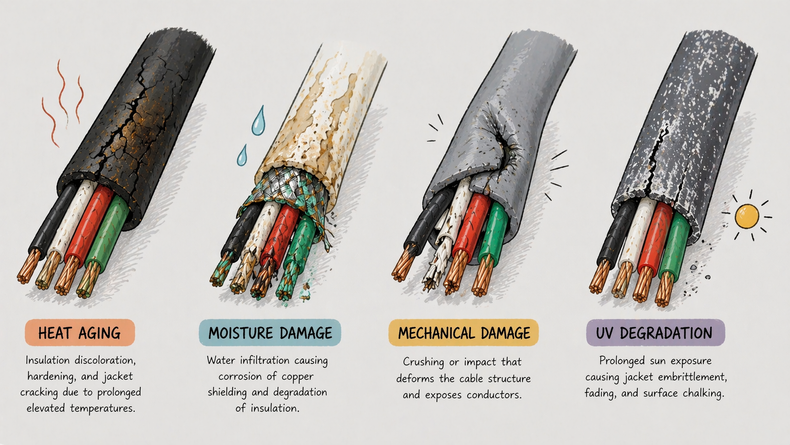
Cable failure traces to a small set of recurring causes: thermal stress from overheating, moisture ingress into the cable's interior, mechanical damage during installation or service, chemical and environmental exposure, electrical stress from overvoltage or partial discharge, and installation or design errors. Most failures begin as slow degradation of the insulation or jacket long before a visible fault, which is why cable condition assessment and environment-matched specification are central to long-term reliability. A cable operated within its ratings and protected from external damage commonly serves decades; one operated outside its ratings or in the wrong environment can fail in a fraction of that time.
The Common Cable Failure Modes
Most cable failures fall into one of six categories. The categories overlap in service — a mechanical nick in a jacket admits moisture, which accelerates insulation aging, which lowers dielectric strength, which allows a partial discharge to initiate electrical breakdown — but identifying the initiating cause is useful for both investigation and prevention.
- Thermal stress and overheating. The conductor runs hotter than the insulation is rated to tolerate.
- Moisture ingress. Water enters the cable through damaged jacket or poorly sealed terminations.
- Mechanical damage. The cable is cut, crushed, over-bent, or abraded during install or service.
- Chemical and environmental exposure. Solvents, oils, ultraviolet light, ozone, or salt degrade the jacket or insulation.
- Electrical stress and dielectric breakdown. Overvoltage, partial discharge, tracking, or treeing degrade the insulation from within.
- Installation and design errors. The cable is the wrong type for the environment, improperly terminated, or misapplied in the circuit.
Thermal Stress and Overheating
Sustained operation above a cable's temperature rating accelerates chemical degradation of the insulation — oxidation, plasticizer migration in PVC, cross-link degradation in XLPE, and mechanical embrittlement of the jacket. The Arrhenius relationship that governs these reactions means small temperature excursions, accumulated over time, have disproportionate effect on service life.
Common sources of thermal stress include undersized conductors relative to the load, ampacity derating factors that were missed in design (ambient correction or conductor grouping), poor ventilation around the cable run, and installation environments hotter than the ambient assumed in the ampacity tables. Detail on how temperature rating interacts with ampacity sits in temperature ratings in electrical cables.
Moisture Ingress
Water entering a cable's interior has two destructive effects. First, dissolved salts and ions increase the insulation's leakage current, lowering its effective dielectric strength. Second, in XLPE-insulated cable operated at medium or high voltage, moisture enables a progressive failure mechanism called water treeing, in which microscopic water-filled channels grow through the insulation along the electric-field gradient and eventually initiate electrical treeing and breakdown.
Typical moisture entry points include jacket punctures, damaged or unsealed cable ends, terminations installed without adequate sealing, and poorly protected splices. Direct-burial and submersible cable are particularly exposed, and damaged jackets on these constructions are frequent root causes of field failure.
Mechanical Damage
Mechanical damage may be introduced during installation or during service. During installation, excessive pulling tension, bend radius tighter than specified, crushing under supports, and abrasion against sharp edges of conduit or trays can all compromise the jacket or conductors. During service, vibration fatigue (particularly in flexing portable and drive-connected cable), impact from nearby equipment, and excavation strikes on buried cable are common causes of damage.
Rodents, insects, and other biological agents also cause mechanical damage to cable jackets — particularly in buried, outdoor, and attic installations. Jacket compounds with increased hardness or bitter taste additives are sometimes specified where rodent damage is a recurring issue.
Chemical and Environmental Exposure
Jacket and insulation compounds are chosen for compatibility with the installation environment; a mismatch accelerates failure. Common chemical and environmental stresses include:
- Ultraviolet light. UV exposure degrades many jacket compounds, embrittling the outer layer over time. UV-resistant jackets and sunlight-resistant markings identify cable designed for outdoor exposure.
- Ozone. Ozone cracks certain rubber compounds; cable used near ozone-producing equipment (some motors, corona sources) requires ozone-resistant constructions.
- Oils and solvents. Hydrocarbon fuels, cutting oils, and industrial solvents can soften or swell PVC and some rubber jackets.
- Salt and atmospheric contamination. Coastal and marine environments introduce chloride corrosion of metallic shields, drain wires, and terminations.
Jacket and insulation compound selection for these exposures is covered in common cable insulation materials, which maps each compound to the environments it tolerates.
Electrical Stress and Dielectric Breakdown
Electrical failure modes operate inside the insulation, often without external warning. The major mechanisms include:
- Overvoltage transients. Lightning, switching surges, and capacitor-switching events apply voltages above the cable's design margin. Repeated transients cumulatively damage the insulation; a single severe transient can cause immediate breakdown.
- Partial discharge. Small, localized discharges occur in voids, impurities, or stress concentrations within the insulation. Each discharge erodes the surrounding material, growing a channel that eventually becomes a full breakdown path.
- Electrical treeing. A branching pattern of conductive channels grows through the insulation under sustained partial discharge, propagating from voids or contaminants toward a full fault.
- Tracking. Surface discharge along a contaminated or moist insulation surface, particularly at terminations, creates a conductive carbon path that progressively shortens the dielectric distance.
- Corona. A form of partial discharge at the conductor surface in high-voltage cable; adequate conductor and insulation shielding suppresses it.
Operating a cable above its voltage rating — whether continuously or through transients — accelerates all of these mechanisms. The voltage side of cable specification is covered in electrical cable voltage ratings.
Installation and Design Errors
A subset of cable failures traces to errors made before the cable is energized. Common patterns include:
- Specifying the wrong cable type for the environment — a general-purpose cable in a plenum, a dry-rated insulation in a wet location, or a non-direct-burial cable in an earth-contact run.
- Termination errors — improper shield termination, inadequate stress relief, insufficient strain relief on flexing cable, or wrong lug size.
- Improper bonding or grounding of shields, which prevents a shielded cable from performing its EMI-attenuation function and can introduce ground-loop currents.
- Exceeding raceway fill or pull-tension limits during installation, compressing or stretching the insulation before the cable ever carries load.
- Missing or incorrect ampacity derating for ambient temperature, conductor grouping, or installation method.
Signs and Symptoms of Cable Failure
Cable failure is often preceded by observable symptoms. Visual and electrical indicators include:
- Jacket discoloration or cracking. UV exposure, chemical attack, or thermal aging produce visible jacket changes.
- Insulation softening, hardening, or embrittlement. Thermal aging and chemical attack change insulation mechanical properties before they change electrical properties.
- Thermal hot spots. Infrared imaging of energized cable and terminations identifies overloaded or poorly terminated points before the insulation fails.
- Elevated conductor temperature. Indicates current in excess of the ampacity available to the circuit.
- Reduced insulation resistance. An insulation-resistance (megger) test measuring below historical baseline indicates moisture ingress or insulation degradation.
- Partial discharge activity. Medium- and high-voltage cable testing uses partial-discharge measurement to detect internal degradation well before dielectric breakdown.
- Intermittent faults. Nuisance tripping or sporadic signal errors often indicate a marginal insulation or termination condition that has not yet failed completely.
Key Takeaways
- Most cable failures fall into six categories: thermal stress, moisture ingress, mechanical damage, chemical and environmental exposure, electrical stress, and installation or design errors.
- Thermal aging of insulation is cumulative; operation above the temperature rating shortens service life disproportionately via the Arrhenius relationship.
- Moisture ingress enables water treeing in XLPE medium- and high-voltage cable and lowers dielectric strength broadly.
- Mechanical damage during installation is a frequent root cause; damaged jackets create the entry point for moisture, chemicals, and electrical stress.
- Electrical stress failure mechanisms — partial discharge, electrical treeing, tracking, and corona — operate inside the insulation and often show no external warning.
- Installation errors, including wrong cable type and improper termination, produce failures that look like field conditions but originate in the design or build.
- Visual jacket changes, infrared hot spots, reduced insulation resistance, and partial-discharge activity are common precursors to outright failure.
Frequently Asked Questions
Why does electrical cable fail?
Electrical cable fails through a small set of recurring mechanisms: thermal stress from operation above the insulation's temperature rating, moisture ingress through damaged jacket or terminations, mechanical damage during installation or service, chemical and environmental exposure that degrades jacket and insulation compounds, electrical stress that initiates partial discharge and dielectric breakdown, and installation or design errors that apply the wrong cable to the environment. In service, these mechanisms often combine — a mechanical nick admits moisture, moisture lowers dielectric strength, and electrical stress completes the failure.
How long does electrical cable last?
Service life varies with cable type, installation environment, and operating conditions, so a single universal figure does not apply. Building wire installed within its ratings, in a controlled indoor environment, commonly exceeds several decades of reliable service. Medium-voltage XLPE cable operated within its ratings also serves decades, though moisture ingress can significantly shorten that figure in poorly sealed installations. Cable operated above its ratings, exposed to harsh chemical environments, or damaged mechanically can fail in a small fraction of the rated life.
What are the signs of cable insulation breakdown?
Observable indicators include jacket discoloration or cracking, insulation softening or embrittlement, elevated conductor temperature, thermal hot spots visible under infrared imaging, reduced insulation resistance measured against historical baseline, partial-discharge activity detected during medium- and high-voltage testing, and intermittent electrical faults. Each indicator reflects a different failure mechanism, and multiple indicators appearing together typically signal advanced degradation.
Can heat damage cable?
Yes. Sustained operation above the insulation's temperature rating accelerates chemical degradation of both the insulation and the jacket. Thermoplastic compounds such as PVC soften and migrate plasticizers; thermoset compounds such as XLPE lose their cross-link integrity and embrittle. The cumulative effect is loss of dielectric strength and mechanical robustness long before outright failure. Short excursions are less damaging than sustained over-temperature operation, but both consume the cable's thermal-aging margin.
What is water treeing in a cable?
Water treeing is a progressive insulation failure mechanism specific to polyethylene-based (XLPE and PE) medium- and high-voltage cable operated in the presence of moisture. Microscopic water-filled channels grow through the insulation along the electric-field gradient, driven by the alternating electrical stress. Over years of service, the water trees can convert into conductive electrical trees and initiate dielectric breakdown. Moisture-barrier jacket constructions and tree-retardant insulation compounds reduce susceptibility.
Related reading on Ongauge: difference between wire and cable, common cable insulation materials and their properties, electrical cable voltage ratings, and temperature ratings in electrical cables.