 Free Shipping $1,000+

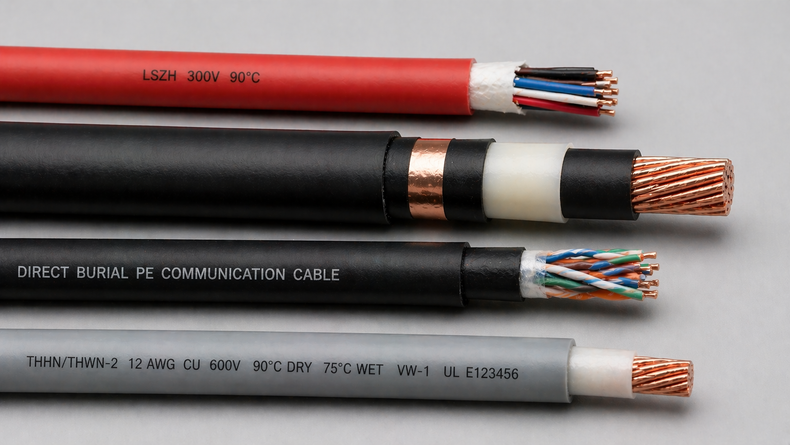
Cable insulation materials define a cable's temperature range, dielectric strength, fire behavior, chemical resistance, and flexibility. The most common families are polyvinyl chloride (PVC), cross-linked polyethylene (XLPE), polyethylene (PE), and low-smoke zero-halogen (LSZH) compounds. Fluoropolymers such as FEP, PFA, PTFE, and ETFE cover higher-temperature and plenum applications, and rubber compounds such as EPR, neoprene, and silicone handle flexible, portable, and specialty runs. Each material family maps to a set of installation environments and performance tradeoffs.
The Role of Cable Insulation
Cable insulation serves two distinct functions. The primary insulation on each conductor isolates conductive paths from one another and from ground, establishing the cable's voltage rating and dielectric performance. The outer jacket protects the internal construction from moisture, abrasion, chemicals, sunlight, and mechanical damage in the installation environment.
Both layers are selected from the same general families of polymer and elastomer compounds, but the performance targets differ. Primary insulation is optimized for dielectric strength, thermal resistance, and electrical stability over time. Jacket compounds are optimized for mechanical toughness, chemical resistance, and in some cases fire behavior. Long-term degradation of either layer is one of the common causes of cable failure, which is why material selection is central to specifying cable for a given environment.
Polyvinyl Chloride (PVC)
PVC is the most widely used cable insulation and jacket material. It is a thermoplastic — meaning it softens with heat and can be extruded and reformed — with good dielectric properties, moderate flame resistance, and broad chemical tolerance at a low material cost.
PVC formulations are commonly rated for continuous conductor temperatures of 60°C, 75°C, 90°C, or 105°C depending on the specific compound. The choice among these grades directly affects the cable's ampacity; higher-temperature PVC allows the conductor to carry more current without exceeding the insulation's thermal limit. Detail on how these temperature classes shape cable selection is covered in temperature ratings in electrical cables.
PVC is commonly found in THHN and THWN-2 building wire, NM-B residential cable jackets, control cable, communications cable, portable cord jackets (in plasticized variants), and many specialty constructions. Its primary limitation is fire behavior: when PVC burns, it releases hydrogen chloride and dense smoke, which is the reason plenum and some life-safety installations specify halogen-free alternatives instead.
Cross-Linked Polyethylene (XLPE)
XLPE is polyethylene that has been chemically or physically cross-linked into a thermoset network. Cross-linking gives the material higher temperature performance, greater mechanical stability, and better electrical properties than uncross-linked PE — at the cost of not being remeltable.
XLPE-insulated cable is commonly rated for 90°C continuous conductor temperature in wet and dry locations, with higher emergency and short-circuit ratings. Its dielectric strength and stability make it the dominant primary-insulation material for medium-voltage cable, where it is used across a range of electrical cable voltage ratings from low voltage through transmission-class cable.
Typical XLPE applications include XHHW-2 and RHW-2 building wire, USE-2 underground service cable, MV-90 and MV-105 medium-voltage power cable, and photovoltaic (PV) wire engineered for solar-array interconnects. XLPE costs more to manufacture than PVC, but the higher temperature rating, longer service life under thermal cycling, and greater dielectric margin often justify the increase in demanding applications.
Polyethylene (PE)
PE — polyethylene in its uncross-linked form — is a thermoplastic with very good dielectric properties and excellent moisture resistance. Low-density (LDPE), medium-density (MDPE), and high-density (HDPE) variants each carry different mechanical and thermal behavior, but all share low electrical loss at high frequencies.
PE is commonly used as the dielectric in coaxial cable (in solid and foamed forms), as an outer jacket on direct-burial cable where moisture exposure is continuous, and in telephone and outside-plant cable constructions. Its high-frequency electrical performance is a primary reason it dominates coaxial cable dielectrics over PVC. Its principal limitations are a lower continuous temperature rating than XLPE and flammability in the absence of additives.
Low-Smoke Zero-Halogen (LSZH)
LSZH — also written LSOH, LS0H, or HFFR (halogen-free flame-retardant) — is not a single polymer but a family of compounds formulated to release low levels of smoke and no halogenated gases when burned. Typical LSZH compounds use polyolefin or ethylene-vinyl-acetate (EVA) bases with mineral fillers such as aluminum trihydroxide or magnesium hydroxide that absorb heat during combustion.
LSZH is specified where a cable fire's smoke and chemistry are a life-safety concern in addition to the cable's flame propagation. Common applications include transit and rail tunnels, data centers, hospitals, ships, and enclosed public spaces where occupants or sensitive electronics cannot tolerate the acidic, corrosive smoke produced by burning PVC.
LSZH's tradeoffs relative to PVC include higher material cost, typically lower mechanical toughness at equivalent wall thickness, and more complex compounding. Jacket and insulation formulations continue to evolve to close the mechanical gap.
Specialty Insulation Compounds
Beyond the four common cable insulation types above, several other compounds appear in specialty applications:
- Fluoropolymers (FEP, PFA, PTFE, ETFE). High-temperature, chemically inert compounds with continuous ratings commonly reaching 150°C to 260°C depending on the polymer. Used in plenum communications cable (FEP conductor insulation), chemical-plant instrumentation, aerospace wiring, and high-temperature motor leads.
- Ethylene-propylene rubber (EPR). A thermoset elastomer used as primary insulation in medium-voltage cable and as a flexible insulation in portable power cable. EPR handles thermal cycling and flexing better than XLPE in applications where the cable moves during service.
- Neoprene (polychloroprene). A flame-resistant, oil-resistant synthetic rubber used as a jacket on welding cable, mining trailing cable, and heavy portable cord.
- Silicone rubber. A high-temperature, flexible insulation commonly rated from approximately 150°C to 200°C continuous, used in appliance internal wiring, motor leads, and heating-element lead wire.
- Nylon (polyamide). A thin, tough outer layer extruded over PVC in THHN/THWN conductors to improve chemical resistance, abrasion resistance, and pulling performance through conduit.
- Thermoplastic elastomers (TPE, TPU). Flexible compounds used in industrial cables where repeated mechanical cycling, cold temperatures, or chemical exposure exceed the limits of PVC.
Material Comparison
| Material | Class | Typical continuous temperature | Notable properties | Common applications |
|---|---|---|---|---|
| PVC | Thermoplastic | 60-105°C (formulation-dependent) | Low cost, wide chemical tolerance, releases HCl and smoke when burned | THHN, NM-B, control, communications, general jackets |
| XLPE | Thermoset | 90°C in most building-wire applications | High dielectric strength, good thermal stability | XHHW-2, RHW-2, USE-2, MV cable, PV wire |
| PE | Thermoplastic | Lower than XLPE; varies with density | Excellent moisture resistance, low dielectric loss | Coax dielectric, direct-burial jackets, outside plant |
| LSZH | Compound family | Formulation-dependent | Low smoke, no halogen release when burned | Transit tunnels, data centers, hospitals, marine |
| FEP | Fluoropolymer thermoplastic | Commonly 150-200°C | Plenum fire performance, chemically inert | Plenum communications cable, chemical-plant wiring |
| EPR | Thermoset elastomer | 90°C in most power applications | Flexibility, thermal cycling tolerance | MV cable, portable power cord |
| Silicone | Elastomer | Commonly 150-200°C | High-temperature flexibility | Motor leads, appliance wiring, heating-element leads |
Key Takeaways
- PVC is the most common cable insulation and jacket material, available in several temperature grades and used across building wire, control, and communications cable.
- XLPE is a thermoset version of polyethylene with higher temperature, dielectric, and mechanical performance than PVC; it dominates medium-voltage and higher-grade building-wire applications.
- PE (uncross-linked polyethylene) has excellent moisture and high-frequency performance and is common in coaxial dielectrics and direct-burial jackets.
- LSZH compounds release low smoke and no halogens when burned; they are specified where smoke chemistry is a life-safety concern in enclosed occupied spaces.
- Fluoropolymers, EPR, neoprene, silicone, and nylon cover higher-temperature, flexible, and specialty applications where the four common families fall short.
Frequently Asked Questions
What is the difference between PVC and XLPE insulation?
PVC is a thermoplastic that softens with heat and can be reformed; XLPE is a thermoset in which the polyethylene chains are cross-linked into a network that does not remelt. XLPE carries a higher continuous temperature rating than common PVC formulations, greater dielectric strength, and better long-term thermal stability, which is why XLPE is the dominant primary insulation for medium-voltage cable and higher-rated building wire. PVC is less expensive, easier to manufacture, and adequate for the broad majority of low-voltage building-wire, control, and communications applications.
What is LSZH cable used for?
LSZH cable is used in installations where cable burning in a fire could endanger occupants or sensitive equipment with its smoke. Transit tunnels, rail cars and stations, data centers, hospitals, ships, and other enclosed public and industrial spaces are common LSZH environments. The low-smoke and halogen-free properties reduce smoke obscuration during evacuation and reduce corrosive gas damage to electronics after a fire.
Which cable insulation is most heat resistant?
Among the common cable insulation families, fluoropolymers — FEP, PFA, PTFE, and ETFE — and silicone rubber carry the highest continuous temperature ratings, commonly reaching 150°C to 260°C depending on the specific compound. PTFE in particular supports some of the highest continuous-service temperatures in commercially available wire and cable insulation. XLPE and EPR typically operate up to 90°C in building-wire and medium-voltage applications, while standard PVC formulations sit lower.
In what applications is XLPE used instead of PVC?
XLPE is specified where PVC's temperature or dielectric limits would be exceeded, or where a longer service life under thermal cycling is required. Typical XLPE applications that displace PVC include medium-voltage power cable, underground service-entrance cable (USE-2), photovoltaic wire exposed to sustained high ambient temperature, and building wire grades such as XHHW-2 and RHW-2 that operate at 90°C in wet and dry locations. PVC remains the dominant insulation in low-voltage building wire, control cable, and communications cable, where its lower cost and adequate performance align with the installation environment.
What insulation is used in plenum cable?
Plenum communications cable commonly uses fluorinated ethylene propylene (FEP) as the primary conductor insulation, with plenum-rated PVC or LSZH formulations as the outer jacket. The material combination is what allows plenum cable to pass NFPA 262 / UL 910 fire-performance testing without generating excessive smoke or flame travel inside a return-air plenum.
Related reading on Ongauge: difference between wire and cable, electrical cable voltage ratings, temperature ratings in electrical cables, and common causes of cable failure.