 Free Shipping $1,000+

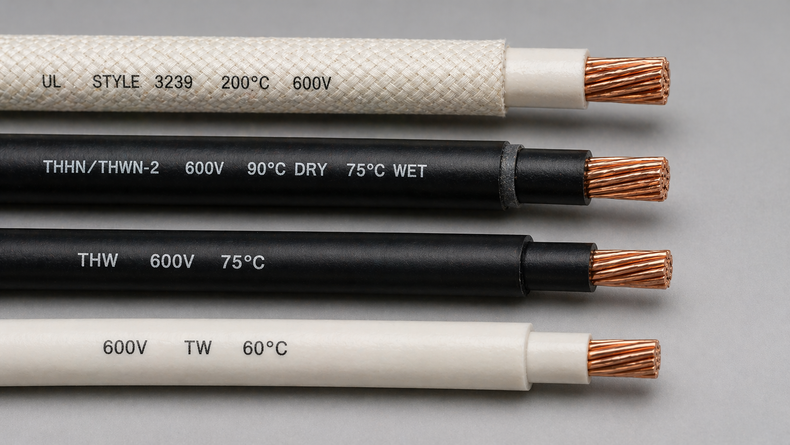
Cable temperature ratings define the maximum continuous conductor temperature at which a cable's insulation is designed to operate without accelerated aging. Common classes in low-voltage building wire include 60°C, 75°C, and 90°C, with higher-temperature specialty cable reaching 150°C, 200°C, and 260°C using silicone, fluoropolymer, or fiberglass insulation. Temperature rating affects ampacity directly: a higher-temperature insulation allows more current through the same conductor size, subject to the temperature ratings of the terminations and equipment at each end of the run.
What a Cable Temperature Rating Means
A cable's temperature rating is the maximum conductor temperature — not the ambient temperature around the cable — at which the insulation system is designed to operate continuously. The rating represents a thermal-aging limit: a temperature above which the chemical degradation of the insulation accelerates enough to shorten the cable's service life below design expectations.
The rating is a property of the insulation compound, not the conductor. A copper conductor can tolerate much higher temperatures than any common insulation; the insulation is the limiting element. Operating below the rating has no adverse effect; operating above the rating accelerates oxidation, cross-link degradation, plasticizer migration, and mechanical embrittlement, depending on the specific compound. The result is gradual loss of dielectric performance and, eventually, insulation failure. Thermal stress is one of the primary common causes of cable failure, which is why temperature rating is paired with voltage rating as a fundamental specification.
Common Temperature Rating Classes
Cable temperature classes span a wide range, with three low-voltage classes covering the large majority of building and industrial wire:
- 60°C. Older cable types such as TW building wire and some legacy UF-B cable; largely displaced in new construction by higher-temperature alternatives.
- 75°C. THW, RHW, USE, and other older wet-rated building wire. Still present in existing installations and specified where 75°C terminations govern the ampacity calculation.
- 90°C. The dominant modern class for low-voltage building wire: THHN, THWN-2, XHHW-2, RHW-2, USE-2, and MV-90 medium-voltage cable. The 90°C rating applies in dry locations for THHN and in both wet and dry locations for \"-2\" suffixed cable.
- 105°C. PVC compounds formulated for slightly elevated service, used in cable such as MTW (machine tool wire) and TFFN fixture wire.
- 150°C to 200°C. Silicone rubber and some fluoropolymer insulation, used in motor leads, heating-element lead wire, and industrial high-temperature wiring.
- 200°C to 260°C. Fluoropolymer insulation — FEP, PFA, and PTFE — used in chemical plants, aerospace wiring, and specialty heater cable.
Each temperature class corresponds to a specific insulation compound family. The compounds and their thermal limits are covered in detail in common cable insulation materials.
Wet and Dry Location Ratings
Certain cable types carry different temperature ratings in wet and dry installations. Absorbed moisture can soften some insulation compounds, reducing their effective dielectric strength and thermal tolerance. Early generations of PVC insulation were particularly affected, which is why older building-wire types carry a lower wet-location rating than their dry-location rating.
Notable examples:
- THHN. 90°C in dry locations, 75°C in wet locations. The different rating reflects moisture uptake behavior of the PVC-and-nylon insulation system.
- THWN-2, XHHW-2, RHW-2, USE-2. The \"-2\" suffix designates cable rated 90°C in both wet and dry locations, achieved through improved insulation formulations.
- UF-B. Direct-burial cable with a wet-location rating consistent with continuous earth contact.
A wet location as defined in the National Electrical Code includes installations in direct contact with earth, areas subject to saturation or immersion, and unprotected outdoor locations exposed to weather.
Temperature Rating and Ampacity
Ampacity — the current-carrying capacity of a conductor — depends on the cable's temperature rating along with ambient temperature, installation method, and grouping with other current-carrying conductors. The National Electrical Code publishes ampacity tables with separate columns for 60°C, 75°C, and 90°C temperature classes. A higher-rated insulation system allows more current in the same conductor size, because the conductor can reach a higher temperature before the insulation's limit is hit.
Two correction factors typically apply on top of the base ampacity:
- Ambient temperature correction. The tabulated ampacities assume a standard ambient (commonly 30°C in free-air and in-conduit tables). When the ambient temperature is higher, the ampacity is reduced by a correction factor to preserve the conductor temperature margin.
- Grouping (adjustment) factors. When more than three current-carrying conductors share a raceway or cable, each conductor's ampacity is reduced because the grouped conductors share heat. Adjustment factors are tabulated by the number of conductors.
Temperature rating is one axis of cable specification; voltage rating is the other. For the dielectric side of the same specification, see electrical cable voltage ratings.
Terminations as a Limiting Factor
A cable's temperature rating is not the sole determinant of the ampacity that can be used in a design. The terminations at each end of the run — circuit-breaker lugs, panelboard bus connections, switchgear terminals, motor-control terminations — carry their own temperature ratings, and the lower of the cable rating and the termination rating governs.
Typical rules that appear in the National Electrical Code's termination provisions:
- Circuit breakers and terminations rated at 100 A or less are commonly restricted to the 60°C ampacity column unless marked otherwise.
- Terminations on circuits above 100 A are commonly restricted to the 75°C column unless marked for higher.
- Equipment marked for 90°C terminations allows the 90°C ampacity column to be used with 90°C-rated cable.
The practical effect: a 90°C-rated THHN conductor terminated at a standard 75°C-rated breaker takes its ampacity from the 75°C column, not the 90°C column. The 90°C rating still matters for correction factors — those are applied starting from the 90°C ampacity — but the final ampacity cannot exceed what the terminations allow.
Emergency and Short-Circuit Temperature Ratings
Beyond the continuous rating, medium- and high-voltage cable typically carries two additional temperature ratings:
- Emergency (overload) rating. A higher conductor temperature permitted for limited hours per year and over the cable's service life. XLPE-insulated cable commonly carries an emergency rating of approximately 130°C, permitted for a restricted cumulative duration defined by the applicable standard.
- Short-circuit rating. A much higher temperature the conductor may reach during a fault, for a duration of seconds before the protective device clears the fault. XLPE cable is commonly rated for approximately 250°C short-circuit.
Both emergency and short-circuit ratings are functions of the conductor material, conductor size, insulation system, and applicable standard; specific values appear on the cable datasheet and in the referenced manufacturing standards.
Temperature Class Comparison
| Rating | Typical insulation | Representative cable types | Common applications |
|---|---|---|---|
| 60°C | Older PVC | TW, legacy UF-B | Existing installations; rarely specified new |
| 75°C | PVC, rubber (RHW) | THW, RHW, USE | Existing installations; 75°C-terminated circuits |
| 90°C | PVC+nylon, XLPE, EPR | THHN, THWN-2, XHHW-2, RHW-2, USE-2, MV-90 | Dominant class in modern building and MV wire |
| 105°C | Heat-resistant PVC | MTW, TFFN | Machine tool wire, fixture wire |
| 150-200°C | Silicone rubber | Silicone lead wire | Motor leads, heating elements, appliance internals |
| 200-260°C | Fluoropolymer (FEP, PFA, PTFE) | FEP-insulated plenum cable, PFA hook-up wire | Chemical plants, aerospace, specialty heat-trace |
Key Takeaways
- Cable temperature rating is the maximum continuous conductor temperature the insulation system is designed to tolerate without accelerated aging.
- Common low-voltage classes are 60°C, 75°C, and 90°C; specialty insulation reaches 150°C, 200°C, and 260°C using silicone and fluoropolymer compounds.
- Some cables carry different ratings in wet and dry locations; the \"-2\" suffix (THWN-2, XHHW-2, RHW-2, USE-2) designates cable rated 90°C in both.
- Temperature rating directly affects ampacity. The NEC publishes ampacity tables with separate 60°C, 75°C, and 90°C columns.
- Ambient temperature and conductor grouping apply correction factors on top of the base ampacity from the appropriate temperature column.
- Terminations have their own temperature ratings; the lower of the cable and termination ratings governs the ampacity used in design.
- Medium- and high-voltage cable also carries emergency (overload) and short-circuit temperature ratings that apply for limited durations.
Frequently Asked Questions
What does the temperature rating on a cable mean?
The temperature rating is the maximum continuous conductor temperature at which the cable's insulation system is designed to operate without accelerated thermal aging. It reflects the thermal limit of the insulation compound — not the conductor — and is the parameter that, along with voltage rating, defines the cable's electrical operating envelope.
What is 90°C-rated cable used for?
90°C cable is the dominant class for modern low-voltage building wire and medium-voltage power cable. Common 90°C types include THHN (dry), THWN-2, XHHW-2, RHW-2, USE-2, and MV-90. The 90°C rating provides the largest ampacity margin among the three standard low-voltage classes, though the usable ampacity in a given installation often depends on the temperature rating of the terminations at each end of the run.
Does temperature rating affect ampacity?
Yes. Ampacity is a direct function of the cable's temperature rating along with ambient temperature, installation method, and conductor grouping. The National Electrical Code publishes ampacity tables with distinct columns for 60°C, 75°C, and 90°C temperature classes. A 90°C-rated cable of a given conductor size carries more current than a 75°C-rated cable of the same size in the same installation, because the conductor is permitted to reach a higher temperature before its insulation's thermal limit is reached.
What happens when a cable exceeds its temperature rating?
Sustained operation above the temperature rating accelerates chemical degradation of the insulation — oxidation, loss of plasticizers, cross-link breakdown, and embrittlement — depending on the specific compound. The cable's dielectric strength decreases over time, and eventually insulation failure can occur through partial discharge, tracking, or flashover. Short-term excursions are less damaging but still consume thermal-aging margin. The effect is cumulative: a cable operated consistently above its rating has a shorter service life than a cable operated at or below the rating.
Why are terminations often limited to a lower temperature than the cable itself?
Terminations — circuit-breaker lugs, panelboard connections, switchgear terminals — are a distinct piece of hardware from the cable, with their own materials and thermal limits. Standard circuit breakers are commonly restricted to the 60°C or 75°C ampacity column in the National Electrical Code, regardless of the cable rating, unless the breaker is specifically marked for higher-temperature terminations. Equipment marked for 90°C terminations allows the 90°C column to be used with 90°C cable.
Related reading on Ongauge: difference between wire and cable, common cable insulation materials and their properties, electrical cable voltage ratings, and common causes of cable failure.